Ltd.
-
‣Ouestions to CBC Council 16th Oct 2017 - Cllr Ian Bickerton.pdf
-
‣LWWHPC LGS Common Ground for Inspector Ord Dec 2015 v05-1.pdf
-
‣Leckhampton with Warden Hill Neighbourhood Planning document with a Local Green Space application.
-
‣CECP Part 2 Chapter 4 Leckhampton with Warden Hill 26-2-17 amended 8-3-17.pdf
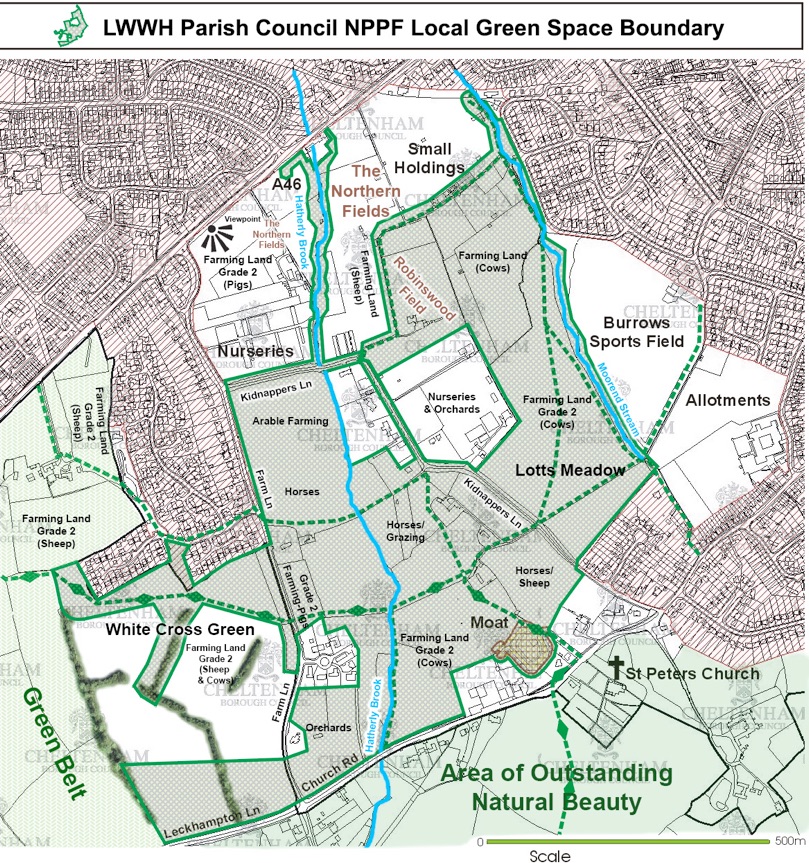
We had an overwhelming response to the Parish Council's Local Green Space application for Leckhampton, we received 774 completed questionnaires representing nearly 1500 residents, thank you! It is now one of twenty nine key green spaces across Cheltenham that could see long term protection from development. Steve Jordan (Leader of the Council) understands the importance of green space to the town and Martin Horwood MP who originally put forward the LGS concept for the National Planning Policy Framework is one of the leading authorities on this new green space designation and has written a comprehensive letter of support for the Leckhampton LGS, please see below.
Neighbourhood Plan Themes, hopefully keep it to three main themes plus Warden Hill input:
-
‣Local Green Space
-
‣Advisory on landscape architecture, design and type of homes sympathetic to the rural character of Leckhampton, fit to the needs of Cheltenham, and infrastructure requirements (primary school etc), this would be across the three potential development areas.
-
‣Traffic and Air Quality Considerations
-
‣Pull in all the requirements from the Warden Hill NP work
Cheltenham Borough Council have recently published the final LGS list, whittled down from the original 110 applications, see Jack Maidment's Echo Report
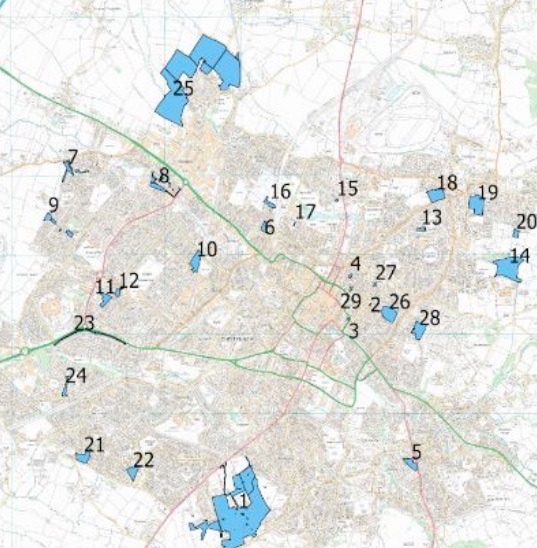
29 Local Green Spaces across Cheltenham which made the shortlist from the original 110 submitted
To quote Steve Jordan, leader of the council, 'Green spaces are not only important for our health and well-being but are a vital part of making Cheltenham the place it is, somewhere where people will thrive, be inspired and generate prosperity for both their families and the community'.
'I welcome the work of officers and GRCC in bringing together the initial views of Cheltenham's Parish Councils and neighbourhood groups on which areas of the borough they feel are of particular beauty, historic significance or recreational value. An opportunity exists for increasing existing protection to a designation now identified in national policy and so this should be fully explored'.
Cheltenham residents are very appreciative of the support from the Council and again last week in the House of Commons when Martin Horwood spoke on the subject in the NPPF debate, please see below and link.
This is the final form of the Leckhampton Local Green Space application and some of the letters of support, it was all done in very quick time, the Parish Council did an amazing job of getting the public consultation forms out, collected and analysed.
LGS Documents - Application & Supporting Letters
-
‣Leckhampton Fields LGS application minus Appendices 4-11 (for ease of emailing to community).pdf
-
‣LGS consultation A0521 attachment - Martin Horwood MP summary.pdf
-
‣Local Green Space - Letters of Support Iain Dobie County Councillor .pdf

more to be added...
We cannot be sure how Cheltenham Council will proceed with these Local Green applications, the county officers at the Gloucestershire Rural Community Council (GRCC), Elin Tattersall and Molly Gallagher did an excellent job of pulling together all the evidence in very quick time to meet the February deadline. We hope Cheltenham Council will be making some form of recommendation to the Inspector at the JCS Examination in Public starting in May. We know the LGS applications have been discussed by the O&A Planning Liaison Task Group but it's being kept under wraps, in the new spirit of Localism the elected councillors should be able to add their views to any recommendation from the Council on these important Local Green Space applications.
We will bring you the news as soon as it comes in, meanwhile keep writing those letters into the Echo and The Standard, they really count.
Ian Bickerton and Margaret White
(250473) (523668)
National Planning Policy Framework
– in Westminster Hall at 12:00 am on 5th March 2015.
Martin Horwood Liberal Democrat, Cheltenham 2:40 pm, 5th March 2015
It is a pleasure to follow Fiona Bruce and other hon. Members who have spoken, including my neighbours, the hon. Members for Tewkesbury (Mr Robertson) and for The Cotswolds (Geoffrey Clifton-Brown). I congratulate the hon. Member for The Cotswolds on securing a debate of sufficient length to allow us all to make a decent contribution on this difficult subject.
In passing, I pay tribute to my right hon. Friend Sir Alan Beith, since I may not get another opportunity before he stands down at the general election. He has made an outstanding contribution to Parliament on behalf of his constituents and our party over an extraordinary period—more than 40 years—and Parliament will be the poorer without him.
Planning ought to have been a reasonably harmonious issue for the coalition, because although the Conservatives and the Liberal Democrats may have had lots of other disagreements, and although we had to compromise in areas, we had similar instincts regarding it. We were all opposed to the old top-down, heavy-handed regional spatial strategies imposed on us by the previous Labour Government. There were good ideas from the Conservative side, such as neighbourhood plans, which many Liberal Democrats wished we had thought of first, and ideas from the Liberal Democrat side, including the local green space designation, which I helped develop and which has been enthusiastically picked up by the council in the constituency of the hon. Member for The Cotswolds, as well as by my council and many others.
As other hon. Members said, the national planning policy framework has certainly improved the accessibility of the planning rules, by reducing them to a manageable size. Among its core principles are many promising statements, including that planning should “be genuinely plan-led, empowering local people to shape their surroundings” and should recognise “the intrinsic character and beauty of the countryside”, that it should be about “conserving and enhancing the natural environment and reducing pollution”, and should “encourage the effective use of land by reusing land that has been previously developed”— in other words, brownfield land.
The then Minister, Greg Clark, rightly got a lot of credit for the improvements he made to the national planning policy framework during the drafting process. I found him not at all Angry of Tunbridge Wells, but an accommodating, co-operative Minister in that respect. However, I am afraid that, like other hon. Members, I am disappointed that we seem to have ended up with a rather different experience in practice, locally, all over the country. Despite all the great principles, the NPPF does not seem to have translated into really thorough localism respecting the wishes of local people, and in many cases it has not protected the environment.
I will focus on the experience of the local green space designation. That policy is in the NPPF and the Department has now provided helpful guidance on it, to help local councils adopt it. However, adoption is still patchy. In fact, I think that Cotswold district council and Cheltenham borough council are the only two councils in Gloucestershire to have adopted the practice and encouraged local communities to come forward with green spaces that communities, parish councils and so on might want to protect.
Cheltenham borough council has enthusiastically adopted that policy. A range of applications was reviewed by Gloucestershire rural community council, to which I pay tribute for doing an outstanding job sifting the applications and testing the criteria in the NPPF that applied to the local green spaces. We have some interesting applications, including in Marsh lane in St Paul’s, one of the least well-off parts of my constituency; Newcourt green, on the Cirencester road in Charlton Kings; Cheriton park in Hatherley and the open space at Chargrove nearby; George Readings park, and parks at Henley road and Triscombe road, in Hester’s way; the Victoria cricket ground in Fairview; and a proposed community orchard in Albemarle road in the north of my constituency. Many of these are in areas that are not the archetypal Cheltenham of picture postcards of regency villas; in some cases they are areas where people have to work pretty hard to make a living and are not archetypally leafy suburbs. I am really pleased that all areas of town are using this designation to protect green spaces, including those that are particularly important in the most urbanised areas. The coalition should be proud of introducing that policy.
However, most of these areas are not imminently threatened by development: communities are rightly taking a precautionary approach. The most controversial area where there is an imminent threat of development is in Leckhampton, which local people have been fighting to defend for at least 20 years. My father was the co-founder of the Leckhampton green land action group, which was fighting for it many years ago. Applications for development there have been repeatedly rejected by inspectors. The area was excluded from the most recent Cheltenham local plan on all sorts of environmental grounds, including its recreational use, landscape, wildlife, and archaeological interest, among other reasons. It is demonstrably special to local people. It is not an extensive tract of land: it only surrounds a couple of lanes in the south of Cheltenham. However, people are really fed up—the hon. Member for Congleton described a similar experience—with endlessly fighting and winning appeals and fighting off applications, only to have developers come back with ever more applications, regardless of the judgements made.
The local green space designation should be used to say, “Actually, this area is special to local people. It has value for recreation; for amenity; for people’s mental and physical health; and for absorbing CO2 and particulate pollution. It is free and accessible for people who may be mobility-impaired and for those, whether young or old, who could not necessarily climb the Cotswold escarpment”—into the constituency of the hon. Member for The Cotswolds—“and is special enough to merit that protection so that local people do not have to fight off the developers for decade after decade.” That is the direction in which the Cheltenham local plan is developing—and indeed the neighbourhood plan being developed by Leckhampton and Warden Hill parish council.
However, there is another problem: the duty to co-operate, which in Gloucestershire is expressed through the Gloucester, Cheltenham and Tewkesbury councils’ joint core strategy. I am afraid I do not share the enthusiasm of Robert Neill for joint core strategies at the moment, because our experience of them is bad—let alone support his idea of a 10-year housing supply rule. That is an horrific idea and would effectively be a developer’s charter.
The duty to co-operate and the emergence of a joint core strategy has caused real problems in Cheltenham. The numbers for the whole three-council area are far too high: they go well beyond local housing need. Effectively, the other councils have refused to accommodate reasonable requests. To say that tempers have flared is putting it mildly. I am afraid that it was a Tewkesbury Conservative councillor who said:
“Cheltenham had really fought long and hard, very greedily, because Leckhampton was the price they wanted to keep.”
He added that Cheltenham was “very precious” about the land at Leckhampton. That kind of language being bantered backwards and forwards is not helpful. Cheltenham was damned if it did and damned if it didn’t. If it stuck to its guns and refused to participate in the joint core strategy and lost its case regarding that overarching planning document, there might have been a developers’ free-for-all and any area that was not already green belt would probably have been even more vulnerable. However, if it agreed to the joint core strategy it had to put housing all round the edge of Cheltenham, not only in Leckhampton, but in an area of Cheltenham—Swindon Village, which is in the constituency of the hon. Member for Tewkesbury—where even more housing is proposed. We have an examination in public due in May, yet there are already a whole series of planning applications intended to pre-empt the process—the neighbourhood plan, the local plan and the joint core strategy. Local people are again having to rally support to fend off yet more speculative applications by developers.
The joint core strategy should really have gone through exactly the same process that Cotswold district council and Cheltenham borough council have gone through by seeing whether the areas should qualify for local green space designation, but we got into a really Kafkaesque situation. Before the joint core strategy, local people were told, “We could not designate the area as local green space because that has to be part of the planning process.” There could not be a designation before the joint core strategy was developed. During the development of the joint core strategy, local people were told that it was not appropriate for the local green space to be put into the joint core strategy. They were told that it was more appropriate for that to be set out in the Cheltenham local plan. That was not a requirement—I confirmed this with Ministers and the Planning Inspectorate—but the choice of those developing the joint core strategy. After the joint core strategy had been drafted—it has now been submitted to the Secretary of State—people were told that the whole area still could not be designated as local green space because any subsequent designation in the local plan or the neighbourhood plan had to be compatible with the joint core strategy, which had never considered the local green space. So it was completely impossible for the local community ever to get that designation into the joint core strategy.
At the examination in public, I will be arguing that the joint core strategy—in that respect, at least—is not compliant with national policy. Those developing the joint core strategy have made it completely impossible for the local community, which was working on this issue at local plan and neighbourhood plan level and has decades of experience of development being rejected, to go through a reasonable process of trying to get the area protected.
What are we left with? One option is guerrilla action. I contemplated promising Bovis, Miller and the other developers that if they went ahead and produced an attractive marketing name for the area, I might set up a website called something like iwouldnotbuyahouseroundhereifiwasyou.com, where I would put the flood risk map, which is one of the factors in the area, online under that marketing name and encourage people not to buy houses there. Flood risk is another issue. A recent flood risk map produced by the Environment Agency clearly identifies land at flood risk near Swindon Village, in Leckhampton and in areas downhill of Leckhampton, such as Warden Hill and Hatherley, where the flood risk is associated with being downhill from that green space. We know that green space absorbs floodwater and holds water in the land more effectively than any urban area.
A more attractive option than that kind of guerrilla action is to ask the Minister whether he will strongly request that the Planning Inspectorate respects the core planning principles in the national planning policy framework. Parliament intended them to be respected, and the Planning Inspectorate should give due weight to emerging neighbourhood plans—I completely agree with the comments that the hon. Member for The Cotswolds made on that—and to emerging attempts to designate areas as local green space in local plans, as in Cheltenham.
The Minister should make it clear that the kind of chicanery by which the Gloucestershire joint core strategy team managed to rule out local green space designation at Leckhampton before, during and after its process is out of order and should not be regarded as compliant with national policy. I am not sure whether he will go that far, but it is one detailed way in which we as a Parliament will have to give a bit more direction and say, “We intended localism to be a serious consideration when we drafted the NPPF, adopted it and voted for it in Parliament. We expect the Planning Inspectorate and local planning authorities to respect all parts of the national planning policy framework, not just the presumption in favour of development.”
Neighbourhood Planning Local Green Space Application - a Community led Planning Proposal
16 February 2017